

Language moves fast. One minute a word belongs to a tiny regional community, and the next minute it’s all over TikTok, gaming chats, crypto forums, memes, and everyday conversations. The word “jeet” is one of those strange little expressions that seems simple on the surface but actually carries multiple meanings depending on who is saying it, where they’re from, and what context it appears in.
For some people, “jeet” simply means “Did you eat?” spoken quickly in casual American English. For others, especially in internet culture, the term has become connected to cryptocurrency slang, online stereotypes, or even offensive racial language. In South Asian naming traditions, “Jeet” can also mean victory or triumph, giving the word an entirely different cultural identity. That’s what makes this term fascinating. It’s like a linguistic chameleon, changing color depending on the environment around it.
Modern slang evolves through social media, gaming communities, regional accents, migration, memes, and online subcultures. Researchers studying slang evolution note that meanings often shift dramatically across communities and regions over time.
Before using a term like “jeet,” it helps to understand where it came from, how it’s interpreted, and why some uses are harmless while others can be offensive. Let’s unpack every angle of the word in detail.
The Basic Meaning of “Jeet”
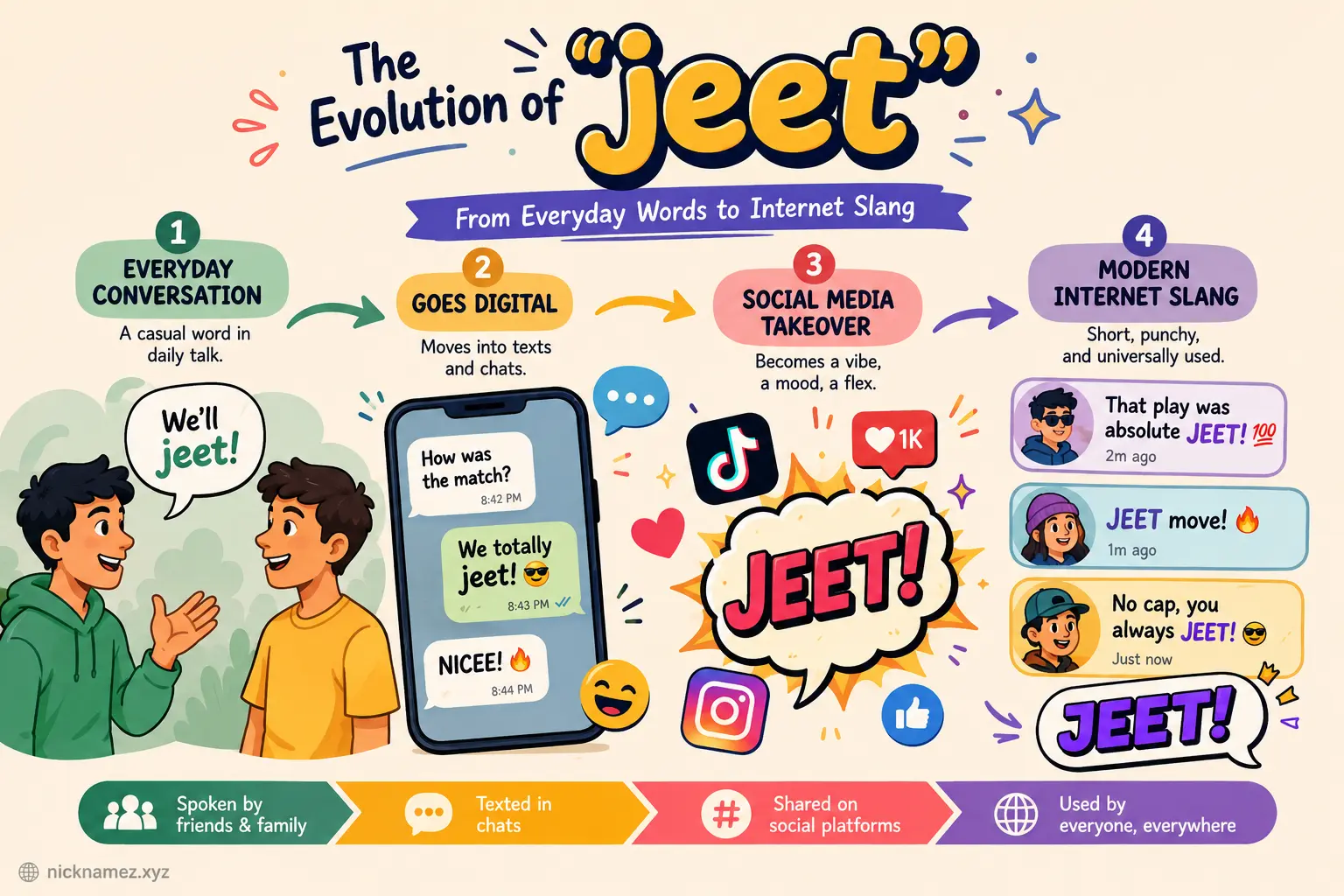
At its simplest level, “jeet” is often just a casual, compressed way of saying “Did you eat?” In spoken conversation, especially in fast-paced regional American English, words naturally blend together. Instead of carefully pronouncing every syllable, people shorten sounds for convenience. “Did you eat?” quickly becomes “D’jeet?” and eventually just “Jeet?”
This kind of language compression happens constantly in English. Think about how “going to” becomes “gonna” or how “want to” becomes “wanna.” Human speech behaves like a river carving shortcuts through a landscape. Over time, people naturally remove unnecessary sounds because efficiency matters in conversation. The word “jeet” follows this exact pattern.
In many households, asking “Jeet yet?” is simply a warm and familiar way of checking whether someone has eaten. It often appears in family settings, among friends, or in local communities where conversational speech is relaxed and informal. Interestingly, many Americans who use the phrase don’t even realize they’re compressing the original sentence. It feels natural because language habits form unconsciously.
Some slang dictionaries and regional speech references identify “jeet” primarily as this shortened phrase. The expression has especially strong roots in conversational American dialects where quick pronunciation patterns dominate daily speech.
The important thing to understand here is that this meaning of “jeet” is generally harmless, friendly, and rooted in ordinary spoken language rather than internet culture or controversy.
The Historical Origins of the Expression
The phrase “jeet” likely emerged from spoken American English decades ago, particularly in working-class and regional communities where pronunciation naturally became compressed over time. Linguists have long observed that spoken English constantly simplifies itself. People rarely speak with textbook precision during casual conversation.
Historical references to expressions like “Jeet yet?” can be found in American regional speech traditions dating back many years. In areas like Philadelphia, parts of the Midwest, and sections of the Northeast, rapid conversational blending became part of local identity. These speech habits weren’t invented online. They existed long before social media.
Imagine language like clay rather than stone. Every generation reshapes it slightly. Regional accents, immigration patterns, and neighborhood culture all leave fingerprints on the way words evolve. In communities where people spoke quickly and informally, phrases like “Did you eat?” naturally merged into smoother sounds.
Some sources trace the expression’s spread through Italian-American and working-class neighborhoods in cities like Philadelphia and Boston. These environments often produced distinctive speech shortcuts that later spread into broader American slang.
One fascinating aspect of language evolution is that many slang terms begin as ordinary speech habits rather than deliberate inventions. Nobody sat down and formally created “jeet.” It emerged organically through repeated conversational use. That organic growth is exactly why the word feels natural when spoken aloud.
This historical background matters because it separates the original phrase from newer internet-related meanings that appeared much later.
How “Jeet” Became Popular in Casual Speech
Casual speech thrives on simplicity, rhythm, and emotional connection. The reason “jeet” survived and spread is because it sounds quick, friendly, and conversational. Asking someone “Jeet?” feels warmer and more relaxed than formally asking, “Have you eaten yet?”
In many cultures, food-related questions are expressions of care rather than literal inquiries. Asking if someone ate is often another way of saying, “Are you okay?” or “How are you doing?” That emotional undertone helped keep the phrase alive across generations.
As internet culture exploded during the 2000s and 2010s, regional expressions began traveling faster than ever before. Social media platforms turned local slang into global slang almost overnight. A phrase once common only in specific neighborhoods suddenly appeared in memes, TikTok videos, YouTube content, and Reddit threads.
Several online discussions describe “jeet” as a recognizable expression in regions like Philadelphia, Michigan, and the broader Midwest. Once people began joking about regional accents online, the phrase became more visible outside its original communities.
Memes also played a huge role. Internet humor loves exaggerated speech patterns because they feel relatable and funny. “Jeet yet?” fits perfectly into meme culture because it sounds quirky while still being understandable.
The rise of texting culture added another layer. Shortened words dominate digital communication because typing speed matters. Just as “u” replaced “you” in many messages, compressed speech forms like “jeet” fit naturally into online conversations.
That combination of regional authenticity, emotional warmth, and internet virality helped the expression remain relevant in modern casual speech.

Regional Variations in Pronunciation and Usage
One of the most interesting things about “jeet” is how differently people perceive it depending on where they grew up. In some American regions, the phrase sounds completely normal. In others, people may never have heard it before.
Philadelphia and nearby Northeastern communities are frequently associated with expressions like “Jeet yet?” or “D’jeetyet?” In these areas, rapid pronunciation patterns blend words together naturally. Residents often don’t even notice the compression until outsiders point it out.
Midwestern speakers also recognize similar patterns. Some Reddit discussions show users from Michigan and Upper Midwest communities saying the phrase feels familiar in everyday conversation. Southern speech traditions contain similar contractions too, although pronunciation may vary slightly.
Regional dialects work like musical accents. Two people can technically say the same sentence but sound entirely different because of rhythm, vowel emphasis, and pacing. “Did you eat?” becoming “jeet” is simply one example of how spoken English adapts locally.
Here’s a quick comparison table showing how the phrase may appear in different speech styles:
| Region or Style | Common Variation | Meaning |
|---|---|---|
| Philadelphia | “Jeet yet?” | Did you eat yet? |
| Midwest | “D’jeet?” | Did you eat? |
| Southern US | “Jeetyet?” | Have you eaten? |
| Formal English | “Did you eat?” | Standard version |
The internet often flattens regional nuance, causing people to assume slang has one universal meaning. In reality, “jeet” changes depending on local culture, online spaces, and social context.
The South Asian Meaning of “Jeet”
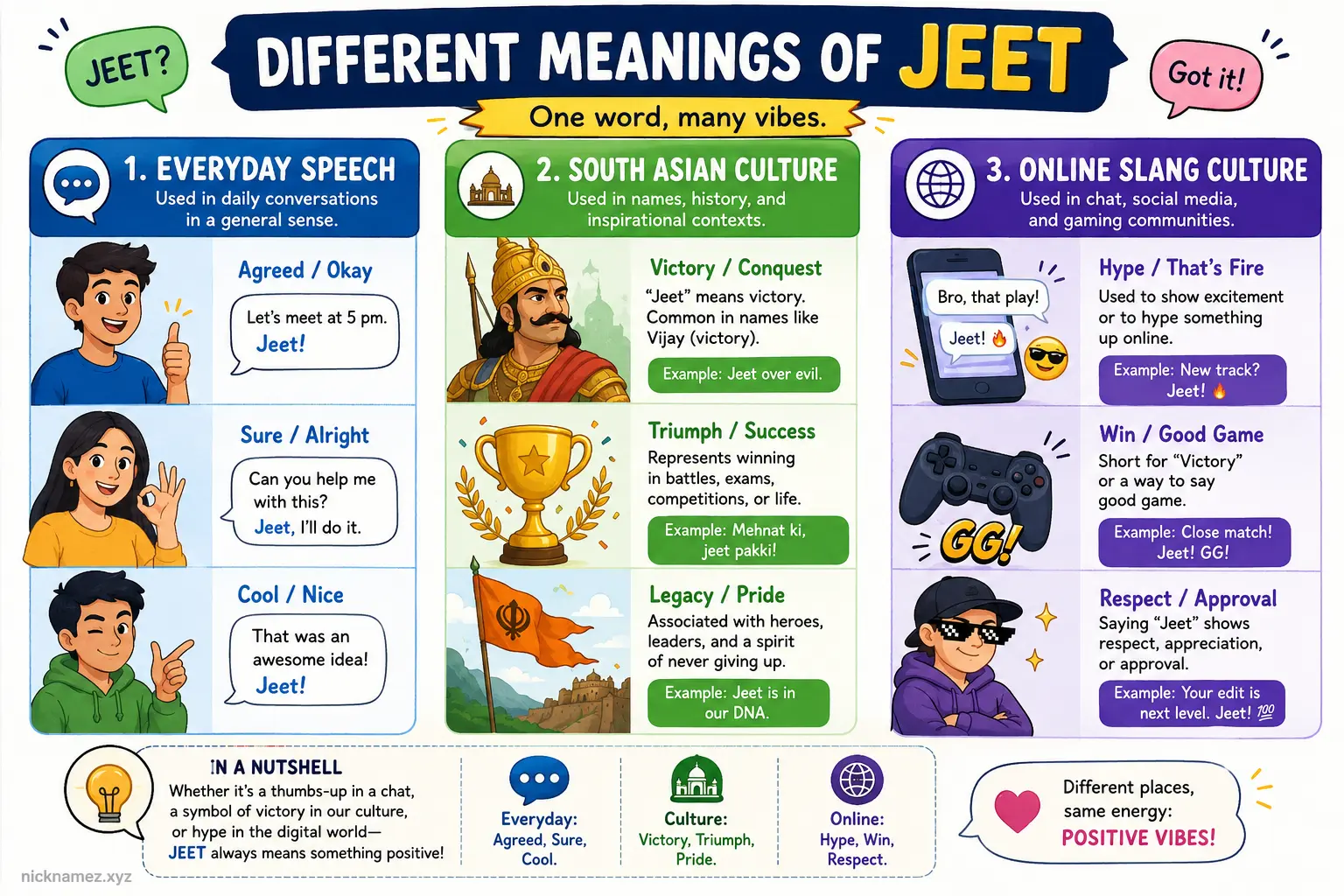
Outside American slang, “Jeet” has a completely different identity rooted in South Asian languages and naming traditions. In Hindi, Punjabi, and Sanskrit-derived languages, “jeet” is associated with victory, success, or triumph.
This meaning appears commonly in names such as Harjeet, Manjeet, or Ranjeet. In these contexts, the word carries positive and honorable associations connected to achievement and strength. Far from slang, it becomes part of personal identity and cultural heritage.
The Sanskrit root “jit” relates to conquering or winning. Over centuries, the term evolved across multiple South Asian languages while retaining its connection to victory.
This creates an unusual linguistic situation where one word carries entirely separate meanings across cultures. To an American hearing “Jeet?” in conversation, it may sound like casual slang. To someone from a Punjabi background, the word may immediately connect to names, family traditions, or cultural symbolism.
Global internet culture often causes these meanings to collide. A word that sounds innocent in one community can feel deeply personal or culturally significant in another. That’s why context becomes essential.
Language rarely belongs to one group forever. Words travel across borders like travelers carrying different stories. “Jeet” is a perfect example of how a single term can develop multiple identities simultaneously.
“Jeet” in Online and Crypto Culture
The internet transformed “jeet” yet again by introducing a newer meaning tied to cryptocurrency culture. In crypto communities, “jeet” often refers to someone who sells investments too early out of fear or panic. Some users interpret it as shorthand for “Just Exit Early Trader.”
In crypto slang, being called a “jeet” usually implies weakness, impatience, or lack of confidence. Imagine a roller coaster passenger jumping off the ride before the biggest climb because they got nervous. That’s basically the stereotype behind the crypto use of the term.
Online investment communities thrive on insider vocabulary because shared language creates group identity. Calling someone a “jeet” signals membership within crypto culture while also mocking cautious traders who sell during market dips.
The rise of meme coins and speculative online trading helped spread the term rapidly during the early 2020s. Platforms like Twitter, Telegram, Discord, and Reddit amplified its popularity.
Here’s a quick breakdown of crypto-related usage:
| Expression | Meaning |
|---|---|
| “Don’t jeet the coin” | Don’t sell too early |
| “He jeeted” | He panic sold |
| “Jeet behavior” | Fearful or impatient trading |
This version of the word has little connection to the original “Did you eat?” phrase. Instead, it reflects the internet’s habit of repurposing language for niche online communities.
The challenge is that internet slang spreads rapidly without preserving context. Someone encountering the word online may misunderstand which meaning applies.
Offensive and Controversial Interpretations
Unfortunately, “jeet” also became connected to controversial and offensive internet terminology through the slur “Pajeet.” Online communities associated with trolling and extremist meme culture used the term to mock South Asians, particularly Indians.
This is where context becomes critically important.
Not every use of “jeet” is offensive. In fact, most everyday uses are completely harmless. However, in certain online spaces, especially anonymous forums or toxic meme communities, the word may appear as part of racist language or stereotypes.
The internet often strips words from their original meanings and repackages them into entirely new cultural contexts. A harmless spoken contraction can suddenly become politically charged because of meme culture or online harassment campaigns.
This doesn’t mean the word itself is inherently offensive in every situation. Language behaves more like a mirror than a weapon. The intention, tone, audience, and context determine how it is understood.
People unfamiliar with these internet subcultures may accidentally misunderstand the word’s meaning. Someone saying “Jeet yet?” at a family gathering is clearly not referencing crypto slang or racial memes. Meanwhile, the same word in a toxic online thread might carry a completely different implication.
That’s why awareness matters. Understanding the multiple meanings allows people to communicate more carefully and avoid confusion.
Common Situations Where People Use “Jeet”
Despite its complicated online evolution, most real-world uses of “jeet” remain casual and conversational. You’ll commonly hear it in relaxed social environments where people speak informally.
Family gatherings are a perfect example. Someone walks into the house, and another person asks, “Jeet yet?” It’s quick, caring, and familiar. The phrase functions almost like emotional shorthand.
Friends also use it jokingly in casual conversation. In some communities, it acts as a cultural marker signaling regional identity or local speech habits.
Online, the word appears in completely different ways. Gamers, meme creators, crypto traders, and social media users may use “jeet” as internet slang unrelated to food or conversation. The tone changes dramatically depending on the setting.
Here are some common scenarios:
| Situation | Likely Meaning |
|---|---|
| Family dinner | “Did you eat?” |
| Midwest conversation | Casual regional speech |
| Crypto forum | Panic selling investments |
| Meme page | Joke or slang reference |
| South Asian name | Victory or triumph |
This variety explains why newcomers often feel confused when they encounter the term online. Without context, the meaning becomes ambiguous.
The modern internet behaves like a giant language blender. Words from different cultures, regions, and subcultures collide constantly. “Jeet” is one of many examples showing how quickly meanings can overlap.
Common Misunderstandings About the Word
One major misunderstanding is confusing “jeet” with similar slang words like “yeet” or “jit.” While they may sound alike, they mean very different things.
“Yeet” usually refers to throwing something energetically or expressing excitement. “Jit,” meanwhile, often refers to a young person or inexperienced individual in Florida slang culture.
Because internet slang spreads through sound and memes rather than dictionaries, people frequently mix these terms together. Someone hearing “jeet” verbally may misinterpret it entirely.
Another misunderstanding involves assuming every use of “jeet” is offensive. This simply isn’t true. Context determines meaning. The original spoken phrase “Did you eat?” existed independently long before controversial online uses appeared.
The same issue happens with many slang terms. Words develop layered meanings over time. One community may use a term affectionately while another uses it negatively. Without cultural awareness, misunderstandings become inevitable.
Social media accelerates this confusion because algorithms push viral meanings faster than historical explanations. A teenager encountering “jeet” through crypto memes might never realize it originated as spoken conversational shorthand.
Understanding slang today requires cultural literacy as much as vocabulary knowledge. You’re not just learning a word; you’re learning the environments that shaped it.
Related Expressions and Similar Slang Terms
“Jeet” belongs to a larger family of compressed conversational slang expressions that emerge naturally through speech. English is filled with these shortcuts because people instinctively simplify communication.
Some related examples include:
| Slang Expression | Standard English |
|---|---|
| Gonna | Going to |
| Wanna | Want to |
| Gotcha | Got you |
| D’ya | Do you |
| Ain’t | Am not/is not |
| Jeet | Did you eat |
These phrases survive because they feel natural in spoken language. Human conversation values rhythm and speed more than grammatical perfection.
Internet culture has also created modern slang cousins to “jeet,” especially words with multiple meanings depending on community usage. Terms like “based,” “cap,” “ratio,” or “cooked” can completely change meaning between generations or online spaces.
Language online behaves almost like software updates. Every few months, communities redefine words, assign new meanings, and spread them globally through memes and viral trends.
The story of “jeet” perfectly captures this process. It began as conversational compression, gained regional identity, expanded through internet culture, entered crypto slang, and eventually became connected to controversial meme communities; all while still retaining its older meanings.
That layered evolution shows how dynamic modern language has become.
Conclusion
The word “jeet” is far more complex than it first appears. Depending on context, it can mean “Did you eat?”, represent a cultural name associated with victory, describe a nervous crypto trader, or appear in controversial internet slang. Few words demonstrate the fluid nature of modern language as clearly as this one.
Its original conversational use reflects the natural tendency of spoken English to compress phrases into smoother, faster sounds. Regional communities helped preserve and spread the expression long before social media existed. Later, internet culture transformed the word into something broader, stranger, and sometimes more controversial.
Understanding “jeet” requires more than memorizing a dictionary definition. It requires understanding culture, community, tone, and context. Language isn’t static. It evolves like a living organism shaped by human interaction.
The next time you encounter the word online or in conversation, pay attention to where it’s being used and who’s using it. That context will tell you far more than the word alone ever could.
FAQs
1. What does “jeet” usually mean in everyday conversation?
In most casual American speech, “jeet” is simply a shortened way of saying “Did you eat?” It commonly appears in relaxed conversations among family or friends.
2. Is “jeet” considered slang?
Yes, “jeet” is considered informal slang or conversational shorthand. It developed naturally through spoken pronunciation patterns rather than formal grammar rules.
3. Why is “jeet” controversial online?
The word became associated with certain offensive internet slang and meme culture, especially through the derogatory term “Pajeet.” Context matters heavily when interpreting the word online.
4. What does “jeet” mean in crypto culture?
In cryptocurrency communities, “jeet” often refers to someone who panic sells investments too early.
5. Does “jeet” have a cultural meaning in South Asia?
Yes. In Hindi, Punjabi, and Sanskrit-based traditions, “jeet” relates to victory, triumph, or success and commonly appears in names.

American content writer and blogger based in Boise, Idaho, age 29. Dorian specializes in creating well-researched digital content focused on lifestyle, technology, and online resources. With several years of professional writing experience, he is known for translating complex topics into practical, reader-friendly articles. He regularly contributes editorial content for nicknamez.xyz while emphasizing accuracy, transparency, and trustworthy research.